Hospitality Industry Accessibility: Creating Inclusive Experiences for Deaf and Hard of Hearing Guests
Designed to Provide Memorable Experiences
The hospitality and entertainment industries are designed to provide memorable experiences, exceptional customer service, and welcoming environments for everyone. However, for many members of the Deaf and Hard of Hearing (DHH) community, communication barriers can make otherwise accessible facilities difficult to navigate independently.
The hospitality and entertainment industries are designed to provide memorable experiences, exceptional customer service, and welcoming environments for everyone. However, for many members of the Deaf and Hard of Hearing (DHH) community, communication barriers can make otherwise accessible facilities difficult to navigate independently.
Hotels, resorts, convention centers, casinos, restaurants, theaters, stadiums, amusement venues, and other entertainment destinations may provide physical accessibility features while still lacking real-time, two-way communication accessibility. A guest may be able to enter a property, access an accessible room, and use the facility, but still experience difficulty communicating with the front desk, concierge, security personnel, event staff, restaurant employees, or emergency personnel.
Accessibility should not stop at physical access. It should include the ability to communicate independently, effectively, and in real time.
The Communication Accessibility Gap
The challenge becomes even greater in environments where communication is frequent, time-sensitive, or critical to safety.
Hotels
Hotels involve numerous interactions between guests and employees, including:
Reservations and check-in
Concierge services
Room changes and special requests
Housekeeping
Maintenance requests
Restaurant and room-service orders
Transportation and valet services
Billing and payment questions
Security concerns
Emergency situations
Without accessible communication, a DHH guest may have difficulty obtaining the same level of service available to hearing guests.
Resorts
Resorts create an even broader range of communication needs.
Guests may interact with employees at the front desk, pools, spas, restaurants, golf facilities, recreational areas, transportation services, and entertainment venues.
A resort that provides accessible communication can allow DHH guests to participate more independently in the complete guest experience rather than limiting accessibility to the guest room.
Convention Centers
Convention centers host conferences, trade shows, corporate meetings, educational programs, and large public events.
DHH attendees may need to communicate with:
Registration staff
Event organizers
Security personnel
Exhibitors
Customer-service representatives
Food-service personnel
Transportation staff
Facility management
Communication accessibility can help ensure that attendees can participate more fully in the event and interact independently with staff and exhibitors.
Entertainment Venues
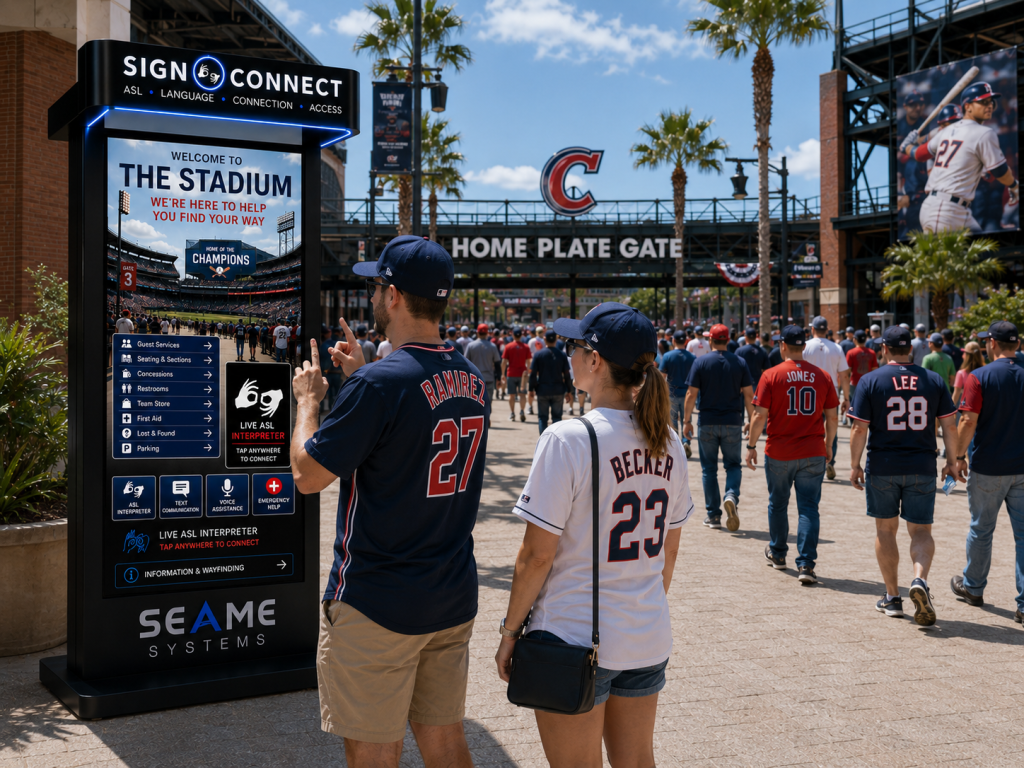
Entertainment venues, including theaters, arenas, stadiums, casinos, amusement parks, and other attractions, present additional accessibility challenges.
Guests may need assistance with tickets, seating, schedules, directions, concessions, security, transportation, lost items, or emergency procedures.
When communication is difficult, the guest experience can be negatively affected even when the physical venue itself is accessible.
Why Real-Time Communication Matters
The DHH community is diverse. Some individuals communicate primarily through American Sign Language (ASL), while others may use spoken language, lip-reading, captioning, assistive listening technology, or other communication methods.
As a result, a single accessibility solution may not meet everyone’s needs.
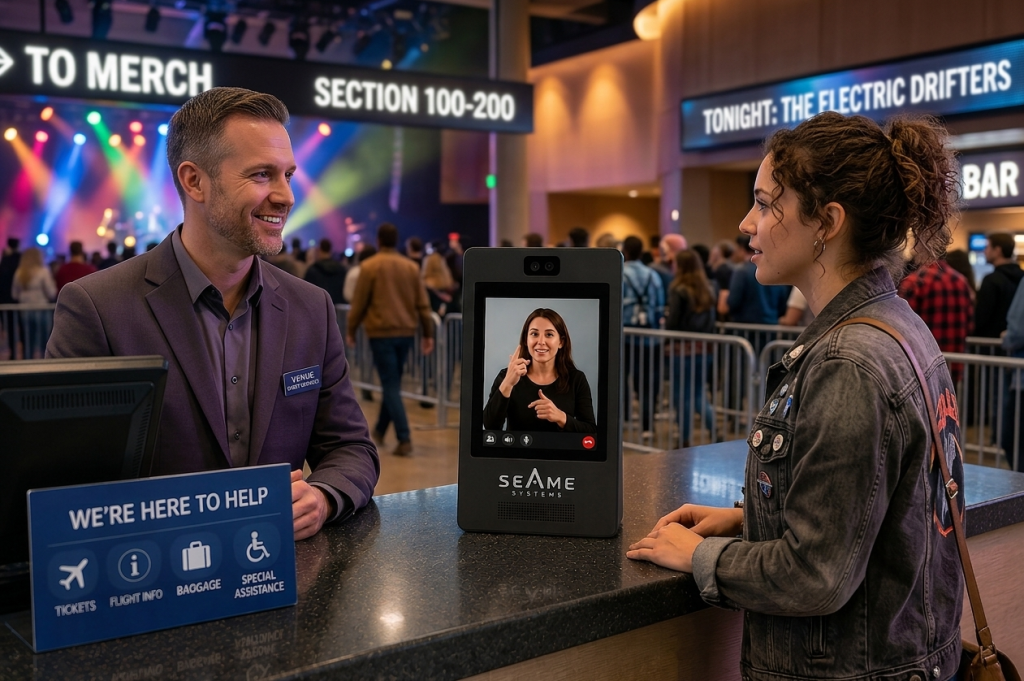
Video Remote Interpreting (VRI) can provide an important additional communication option by connecting a guest and employee with a remote sign-language interpreter through a live video connection.
The basic communication model becomes
DHH Guest>>Video Interpreter>>Hospitality Employee
This allows the guest and employee to communicate directly while receiving professional interpretation support.
DHH Guest >>
Video Interpreter >>
Hospitality Employee >>
The Role of an Accessibility Kiosk
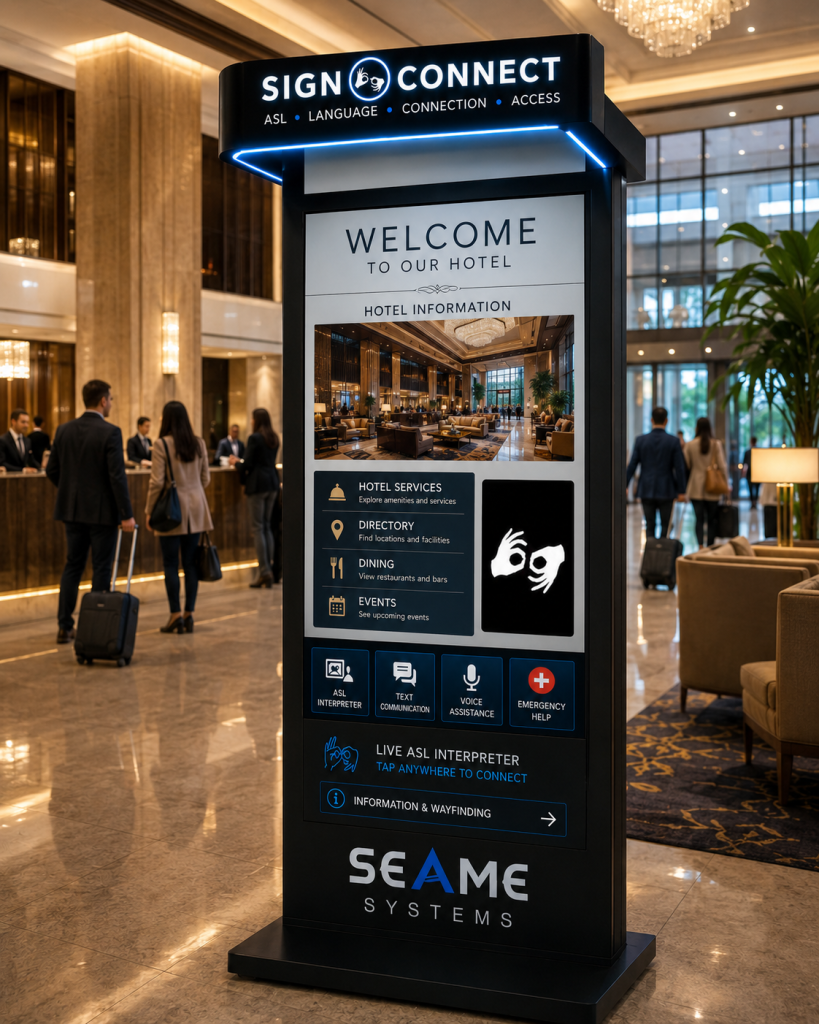
An Accessibility Kiosk
can provide a highly visible
and dedicated access point for communication throughout
a hospitality property.
Potential locations include: Hotel lobbies and front desks
Concierge Areas
Registration areas
Entertainment venue entrances
Stadium and arena guest-services areas
Casino customer-service areas
Theme-park guest-service locations
Transportation and valet areas
Emergency assistance locations
A kiosk can provide DHH guests with a recognizable location where they can access communication assistance when needed.
The Benefits of Combining Kiosks and VRI
Creates Greater Independence
DHH guests should not have to depend on family members, friends, companions, or strangers to communicate with hospitality employees. A kiosk with VRI can give guests a direct pathway to communication assistance.
Improves the Guest Experience
Effective communication can make routine interactions faster, easier, and more comfortable. Instead of struggling to explain a request, the guest can communicate through an interpreter and receive a clear response from the employee.
Improves Customer Service
Hospitality organizations compete heavily on customer experience. Providing accessible communication demonstrates that the organization is prepared to serve a broader range of customers and is committed to treating every guest with dignity and respect.
Enhances Emergency Communication
Communication becomes particularly important during emergencies. In situations involving evacuation, severe weather, medical emergencies, security incidents, fires, or other critical events, DHH guests may need to receive instructions and communicate their needs quickly. A VRI-enabled kiosk can provide an additional communication resource when traditional verbal communication is insufficient.
Supports Employees
Employees should not be expected to be fluent in ASL in order to provide quality service to every DHH guest. VRI can provide employees with access to professional interpretation when specialized communication assistance is required.
Reduces Communication Delays
Writing notes or attempting to communicate through gestures can take considerably longer, particularly when discussing complicated issues. VRI can make communication more efficient and help employees resolve guest requests more quickly.
Creates a More Inclusive Property
Visible accessibility technology communicates that inclusion is an intentional part of the organization’s customer-service strategy. A kiosk can become a recognizable symbol that DHH guests have a dedicated way to obtain assistance.
Expands the Customer Market
Accessibility can also represent a business opportunity. DHH individuals travel, attend conventions, visit resorts, dine at restaurants, attend sporting events, participate in entertainment, and travel with families, friends, and organizations. A property that provides strong communication accessibility may become more attractive to: Individual travelers, Families, Corporate travelers, Convention attendees, Educational organizations, Government agencies, Community organizations, Group-tour operators, Conference planners.
Encourages Repeat Business
When guests have a positive experience at an accessible property, they are more likely to consider returning and recommending the property to others. For hospitality businesses, customer loyalty can be particularly valuable because one satisfied guest can influence the destination choices of an entire family, organization, conference, or travel group.
Differentiates the Brand
Accessibility can become part of an organization’s competitive advantage. Hotels, resorts, convention centers, and entertainment venues that proactively invest in communication accessibility can distinguish themselves by demonstrating that accessibility is more than a compliance requirement—it is part of their overall customer experience.
Beyond Compliance
The hospitality industry’s approach to accessibility is evolving. It is no longer enough to ask whether a Deaf or Hard of Hearing (DHH) guest can physically access a facility. True accessibility also means considering whether that guest can independently communicate with employees, obtain services, participate in experiences, and receive critical information throughout their stay.
This distinction is important because physical access alone does not remove every barrier. Without communication accessibility, DHH guests may still face significant challenges in receiving the same level of service, information, and independence as other guests.
A Comprehensive Accessibility Strategy
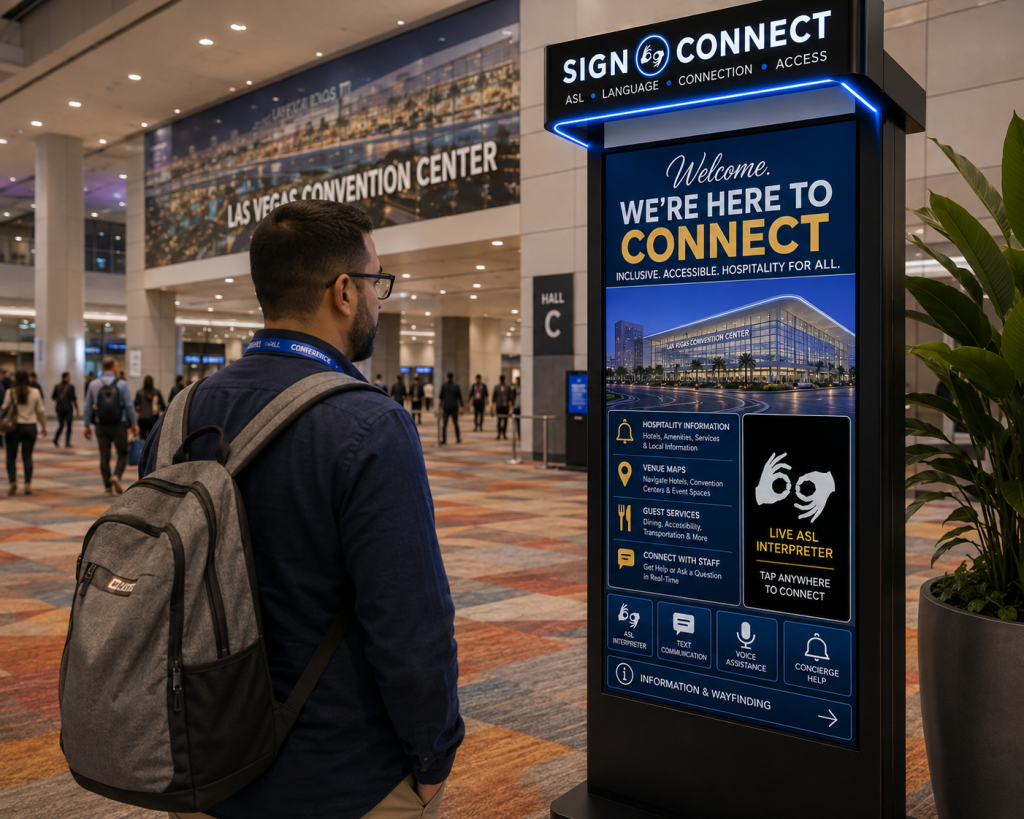
True accessibility in hospitality isn’t a single feature. It’s a combination of physical access, clear visual and captioned information, and direct paths to communication support like kiosks and video remote interpreting, all backed by staff who know how to use them well. Each piece addresses a different barrier a guest might face, from getting through the front door to understanding an announcement to asking a question at the front desk. On their own, these are useful accommodations. Put together, they form a property-wide approach to serving every guest with dignity.
The Business Case for Hospitality Accessibility
It can help organizations:
- Improve guest satisfaction
- Strengthen customer loyalty
- Expand their potential customer base
- Improve employee responsiveness
- Reduce communication barriers
- Enhance emergency preparedness
- Differentiate their brand
- Demonstrate corporate social responsibility
- Create a more inclusive guest experience
The Future of Inclusive Hospitality
The Goal
See the guest. Hear the need. Enable the conversation. Deliver the experience.
For the hospitality industry, communication accessibility is not simply about technology. It is about independence, dignity, safety, customer service, inclusion, and creating an environment where every guest has the opportunity to fully participate.
Get Started
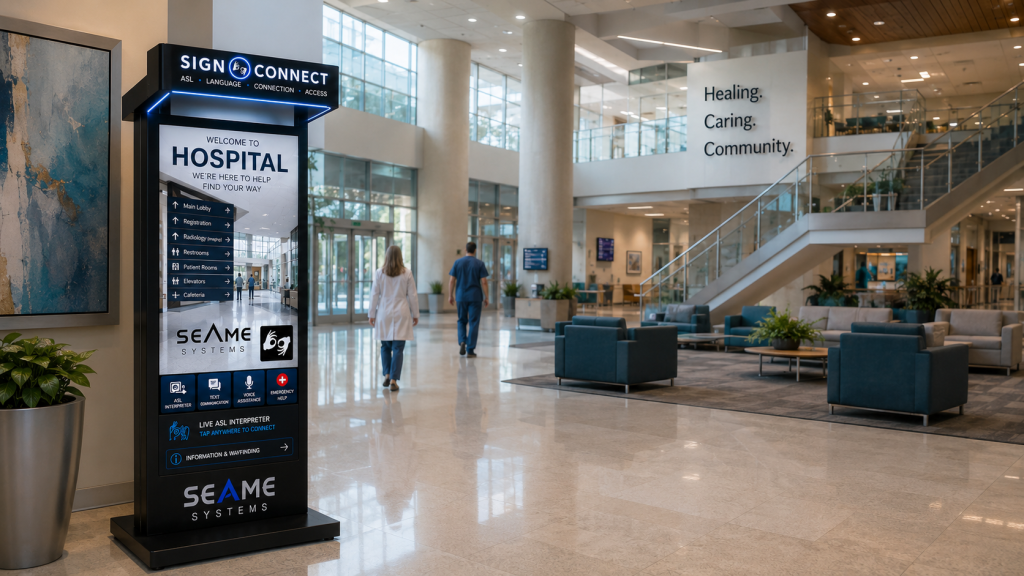
Ready to remove navigation barriers for deaf and hard of hearing patients? SeaMe Systems Sign Connect kiosks helps healthcare facilities design accessible wayfinding solutions that improve patient experience and independence.
Call (951) 447-1133 info@seamesystems.net