
Healthcare Accessibility: Creating Inclusive Communication for Deaf and Hard of Hearing Patients
Accessible Communication for Every Guest
Hotels serve millions of deaf and hard of hearing (DHH) guests, yet everyday interactions can still create communication barriers. From check-in and room service to maintenance requests and emergencies, clear, accessible communication is essential to a positive hotel experience.
Hospitals and healthcare facilities are environments where effective communication can directly affect patient experience, safety, understanding, and quality of care. For members of the Deaf and Hard of Hearing (DHH) community, however, communication barriers can make navigating healthcare services significantly more difficult.
Hospitals, medical centers, urgent-care facilities, specialty clinics, rehabilitation centers, outpatient facilities, and emergency departments often serve patients who need to communicate with numerous employees throughout their visit. These interactions can include registration, triage, nursing, physicians, diagnostic services, pharmacy, billing, security, and discharge.
While healthcare organizations have made substantial investments in physical accessibility, communication accessibility remains an important component of an inclusive healthcare environment.
A patient may be able to enter a hospital, use its facilities, and receive medical services, yet still encounter barriers when attempting to communicate with the people responsible for their care.
The Communication Accessibility Gap
Healthcare communication is often complex, confidential, and time-sensitive.
DHH patients may need to communicate about:
- Symptoms and medical history
- Medications and allergies
- Pain and discomfort
- Treatment options
- Procedures and diagnostic testing
- Consent and authorization
- Insurance and registration
- Follow-up instructions
- Discharge requirements
- Emergency situations
- Questions or concerns about their care

For a patient who primarily communicates through American Sign Language (ASL), relying on written notes, lip-reading, gestures, or family members may not provide the same level of communication access as direct communication through an interpreter.
Healthcare organizations therefore have an opportunity to incorporate technology that makes communication assistance more readily available.
Challenges Throughout the Healthcare Experience
Emergency Departments
Emergency departments are among the most critical locations for communication accessibility.
Patients may arrive under stressful circumstances and need to communicate symptoms, medical history, medications, allergies, pain levels, and other important information quickly.
Communication barriers can make an already stressful situation more difficult.
A dedicated accessibility kiosk with Video Remote Interpreting (VRI) can provide a rapid connection to an interpreter when communication assistance is required.
Registration and Admissions
Registration is often the patient’s first interaction with a healthcare organization.
Patients may need to provide identification, insurance information, medical history, emergency contacts, and other personal information.
Providing an accessible communication option at registration can help patients complete these processes with greater independence and privacy.
Physician and Clinical Interactions
Communication between patients and healthcare professionals is central to quality care.
DHH patients may need to discuss symptoms, understand diagnoses, ask questions, review treatment options, and communicate concerns.
VRI can facilitate communication between the patient, healthcare professional, and interpreter.
Patient ↔ Video Interpreter ↔ Healthcare Professional
This can help create a more effective communication environment.

Diagnostic and Treatment Areas
Communication barriers can continue after the initial examination.
Patients may interact with radiology, laboratory, surgery, rehabilitation, pharmacy, and other departments.
A hospital-wide accessibility strategy can help ensure that communication support is available beyond the front desk.
Discharge and Follow-Up
Discharge instructions can be complex and may include medication schedules, restrictions, warning signs, follow-up appointments, and other important information.
Ensuring that DHH patients can fully understand and ask questions about their discharge instructions can contribute to a safer transition from the healthcare facility to home.
The Role of an Accessibility Kiosk
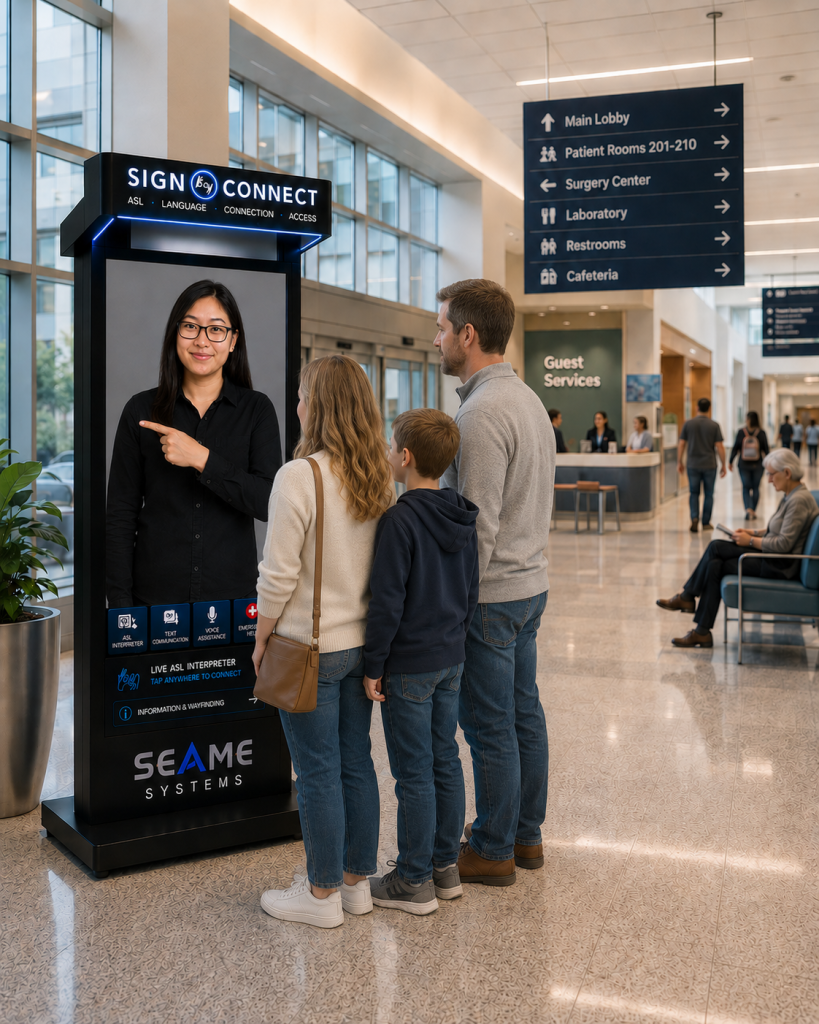
An accessibility kiosk can serve as a visible, dedicated communication access point within a healthcare facility.
Potential locations include:
- Main hospital entrances
- Emergency departments
- Registration desks
- Patient admissions
- Outpatient clinics
- Specialty clinics
- Urgent-care facilities
- Patient-service centers
- Discharge areas
- Pharmacy areas
- Visitor information centers
- Emergency assistance locations
A strategically placed kiosk can give DHH patients an immediate and recognizable way to access communication assistance.
Video Remote Interpreting
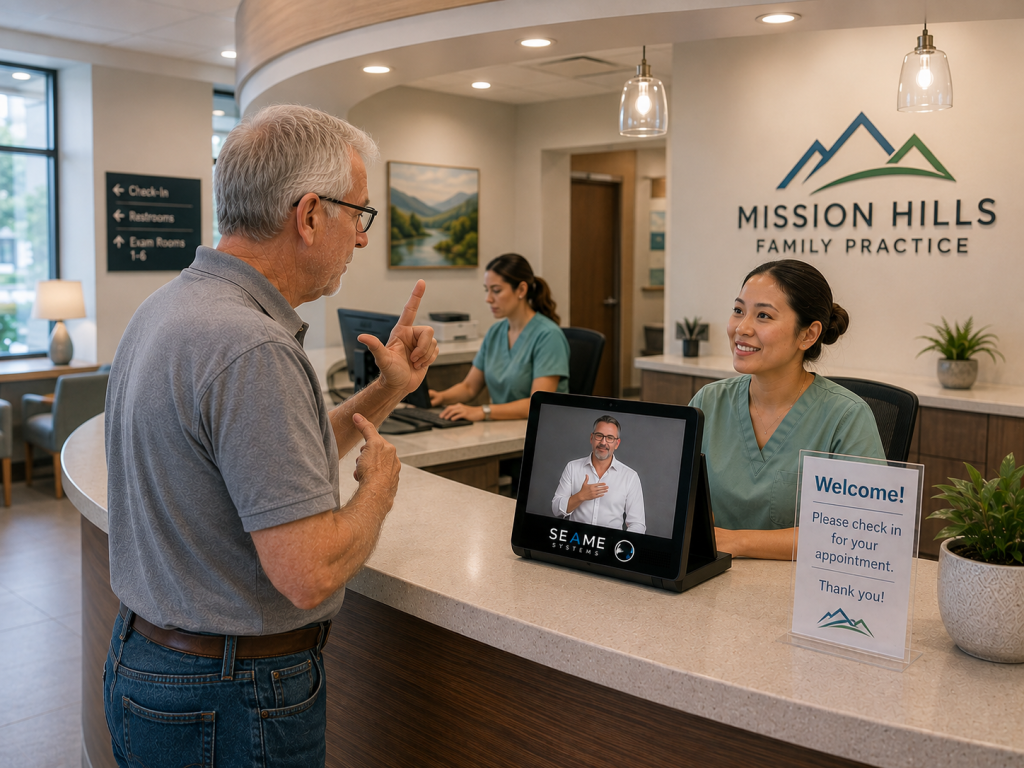
Video Remote Interpreting can connect patients and healthcare professionals with a remote interpreter through a live video connection.
Instead of requiring a patient to find someone who knows sign language, the kiosk can provide a pathway to professional interpretation.
The communication model becomes:
DHH Patient → VRI Interpreter → Healthcare Professional
This can be particularly valuable when an in-person interpreter is not immediately available or when a situation requires rapid communication assistance.
Benefits for Hospitals and Healthcare Facilities
- Improves Patient Communication
Effective communication helps patients explain their needs and understand information provided by healthcare professionals.
A VRI-enabled kiosk can help reduce communication barriers throughout the patient journey.
- Promotes Patient Independence
DHH patients should not have to depend on family members or companions to communicate medical information.
An accessibility kiosk can provide a direct pathway to communication support while promoting greater independence and dignity.
- Enhances Patient Experience
Healthcare experiences can already be stressful.
Providing accessible communication can reduce frustration and help patients feel that they are being heard, respected, and included.
- Supports Patient Safety
Communication is particularly important when discussing:
- Allergies
- Medications
- Symptoms
- Medical history
- Treatment instructions
- Emergency conditions
- Discharge instructions
Improving communication access can support safer interactions between patients and healthcare personnel.
- Improves Emergency Communication
In an emergency, healthcare professionals need to communicate quickly and accurately with patients.
A VRI-enabled kiosk can provide an additional communication resource for DHH patients in emergency departments, hospital entrances, and other critical locations.
- Supports Healthcare Employees
Hospitals cannot expect every employee to be proficient in ASL.
VRI can give employees access to professional interpretation when specialized communication assistance is needed.
This can be particularly valuable in facilities with large and diverse workforces.
- Reduces Communication Delays
Waiting for someone who can communicate effectively with a DHH patient can delay service.
A dedicated kiosk can provide a more immediate pathway to interpretation assistance.
- Provides Greater Privacy
Medical conversations often involve highly personal information.
Using a professional interpreter can help patients communicate medical information without relying on friends, relatives, or other individuals who may not be appropriate for confidential conversations.
- Creates Consistent Accessibility Across the Facility
A hospital may have multiple departments, buildings, entrances, and service areas.
Deploying kiosks strategically can create a consistent communication-accessibility infrastructure throughout the organization.
10. Demonstrates Commitment to Inclusive Healthcare. Visible accessibility technology sends an important message:
Every patient deserves to communicate, participate, and be understood.
An accessibility kiosk can become a tangible representation of the healthcare organization’s commitment to inclusion.

Beyond Physical Accessibility
Healthcare accessibility should encompass more than ramps, elevators, accessible parking, and examination rooms. A truly accessible healthcare environment should address:
Physical Access
Can the patient enter and navigate the facility?
Information Access
Can the patient receive important information?
Communication Access
Can the patient communicate directly with healthcare personnel?
Emergency Access
Can the patient receive and respond to urgent instructions?
Service Access
Can the patient independently obtain the services they need?
The kiosk and VRI model can address an important part of this broader accessibility framework.
Potential Deployment Model
A healthcare organization could establish a communication-accessibility network throughout its facilities.
Main Entrance
Provide an easily identifiable kiosk for patients and visitors who need communication assistance.
Emergency Department
Position a kiosk where DHH patients can quickly access VRI support.
Registration
Use the kiosk to facilitate communication during admissions and registration.
Clinical Areas
Provide access to VRI when patients need assistance communicating with healthcare professionals.
Discharge
Use communication support to help patients understand instructions and ask questions before leaving.
Patient Services
Provide continued communication access for billing, scheduling, insurance, pharmacy, and other non-clinical interactions.

The Business and Operational Value
Accessibility can provide value beyond compliance.
For healthcare organizations, improved communication can help:
- Enhance patient satisfaction
- Improve patient confidence
- Support patient safety
- Reduce communication delays
- Improve employee responsiveness
- Strengthen the patient experience
- Demonstrate organizational leadership
- Support an inclusive healthcare environment
- Improve access to services
Most importantly, it can help healthcare providers deliver a more consistent experience to patients regardless of how they communicate.
The Future of Accessible Healthcare
The future of healthcare accessibility should move beyond simply ensuring that patients can enter a facility.
The goal should be to create healthcare environments where DHH patients can communicate, understand, participate, ask questions, receive instructions, and advocate for themselves throughout their healthcare journey.
Accessibility kiosks combined with Video Remote Interpreting can help hospitals and healthcare organizations close an important communication gap.
The Goal
See the patient.
Understand the need.
Enable the conversation.
Deliver better care.
For hospitals and healthcare facilities, communication accessibility is not simply a technology investment. It is an investment in patient dignity, independence, safety, service, and equitable access to healthcare.

Get Started
Ready to remove navigation barriers for deaf and hard of hearing guests? SeaMe Systems Sign Connect kiosks helps hospitals and healthcare facilities design accessible wayfinding solutions that improve guest experience and independence.
Click the button below to get started.